Skip-Softmax
Skip-Softmax is the sparse-attention mode of the TRTLLM_ATTN backend. It implements BLASST (Dynamic BLocked Attention Sparsity via Softmax Thresholding), which adds a per-tile skip test to the FlashAttention main loop. This page describes the algorithm, how the user configuration is resolved into the value the kernel consumes, and how checkpoint calibration and timestep gating participate in that resolution. Configuration keys and operating-point guidance are covered in TRTLLM Attention; the backend selection contract is covered in Diffusion Attention Backend Selection.
Motivation
In a long attention row (a video DiT can have tens of thousands of keys), the softmax weight concentrates on a small fraction of the keys; the rest receive near-zero weight and barely move the output. Computing softmax and the value-weighted sum over those keys is wasted work. Skip-Softmax detects, per tile of keys, when a tile cannot matter and skips its softmax and its value multiply.
It is approximate: a skipped tile still carries a small non-zero contribution, so the mode is opt-in and off by default.
Algorithm
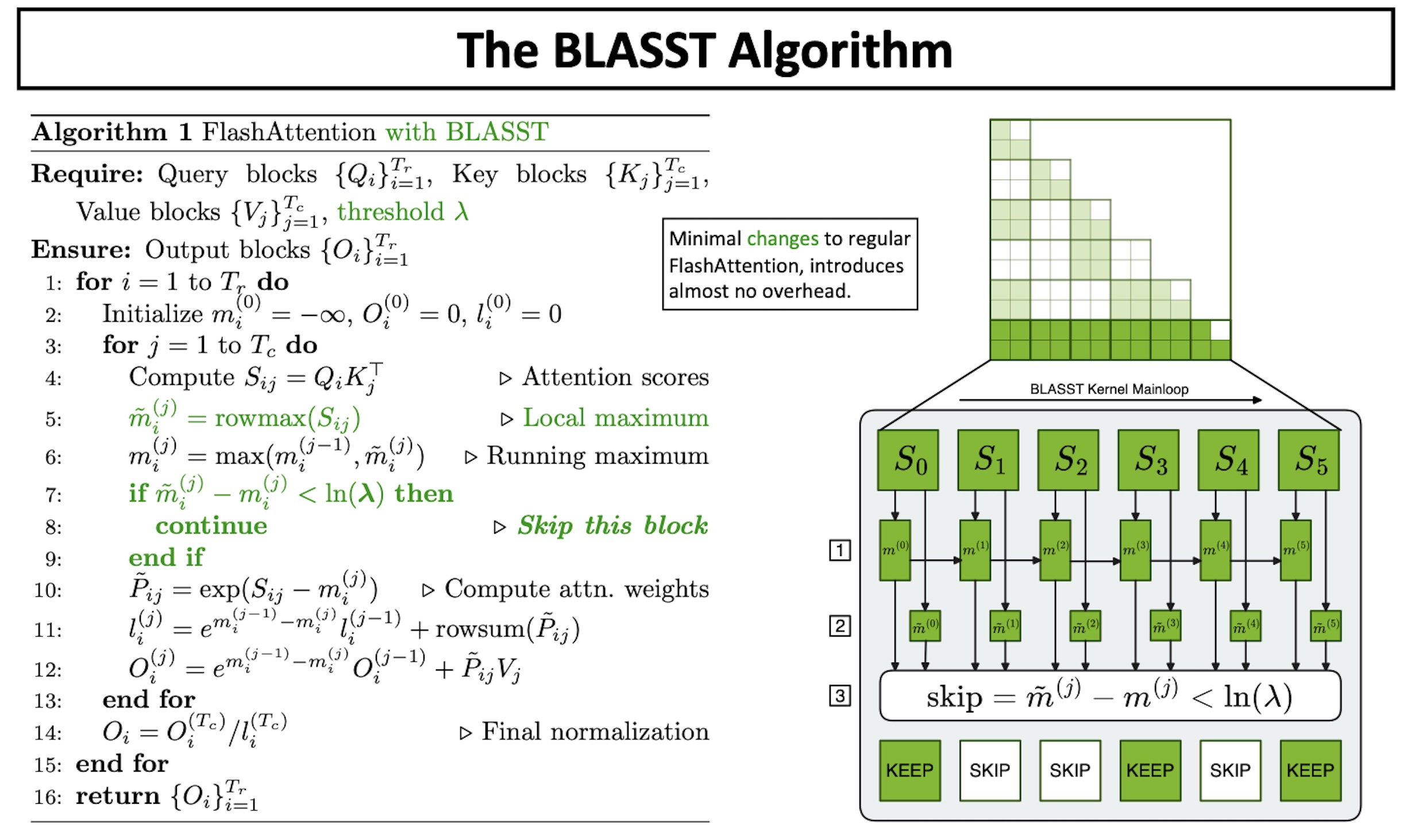
FlashAttention computes attention in a single streaming pass over KV tiles. Per query row the kernel maintains three running values:
m— the largest score seen so far,l— the running denominatorΣ exp(sⱼ − m),O— the running numeratorΣ exp(sⱼ − m)·vⱼ,
and returns O / l at the end. For each KV tile it computes the scores QK_j^T, updates m, and accumulates the tile's contribution into l and O. Rescaling l and O when m grows keeps the dense pass numerically exact.
A tile is a block of query rows against a block of keys, and the kernel processes it as a unit. BLASST inserts one test between computing a tile's scores and accumulating them. For each query row i in the tile, let tile_max[i] be the row's largest score within the tile, running_max[i] the row's running maximum, and λ the effective threshold:
if all(exp(tile_max[i] - running_max[i]) < λ for every row i in the tile):
    skip this tile          # do not compute its Softmax or PV contribution
exp(tile_max[i] − running_max[i]) is an upper bound on the softmax weight any key in the tile can receive in row i: if even the row's best key in this tile is far below the row's current maximum, the tile is unimportant for that row. Only when this holds for every row in the tile can the Softmax and PV work for the tile be skipped, in which case its contribution to l and O is simply omitted. A larger λ makes the test more aggressive. The figure states the same test in log space, m̃ − m < ln(λ), which is how the kernel evaluates it.
The test needs the tile's scores, so QK_j^T always runs and only the Softmax and PV work can be skipped. Since the two matmuls have the same FLOP count, skipping every eligible tile removes at most roughly half of the attention arithmetic, and the kernel-level speedup stays well under 2×.
From configuration to the kernel threshold
The FlashInfer kernel does not take λ directly. It takes a threshold_scale_factor and divides it by the KV sequence length of the call:
vLLM-Omni resolves the factor from one of two mutually exclusive user controls:
| Control | Factor passed to the kernel | Resulting λ |
|---|---|---|
threshold | threshold * max_kv_len | threshold |
target_sparsity=s | a * exp(b * s) | a * exp(b * s) / max_kv_len |
threshold is therefore λ itself and is independent of sequence length: the same value yields the same per-tile test at any resolution or frame count. threshold=0 skips no tiles. Because the left-hand side of the skip test lies in (0, 1], values in (0, 1) are the meaningful range; the schema accepts any finite non-negative value.
target_sparsity selects a point on a curve fitted per model by NVIDIA ModelOpt, so that s lands near that fraction of skipped tiles on the calibration data. The coefficients a and b come from the checkpoint; the achieved sparsity on another prompt, shape, or layer can differ.
Skip-Softmax calibration config
ModelOpt stores the calibration in each transformer component's config.json under sparse_attention_config. The following is taken from the transformer/config.json of nvidia/Wan2.2-T2V-A14B-Diffusers-FP8, with the ignore list abridged:
{
  "sparse_attention_config": {
    "config_groups": {
      "group_0": {
        "algorithm": "skip_softmax",
        "targets": ["WanAttention"],
        "ignore": ["blocks.0.attn1", "blocks.0.attn2", "blocks.1.attn1", "..."],
        "threshold_scale_factor": {
          "formula": "a * exp(b * target_sparsity)",
          "coefficients": {"a": 2822.6209952221557, "b": 4.388250623520793}
        },
        "target_sparsity": 0.7,
        "disabled_until_timestep": 0.93
      }
    }
  }
}
A checkpoint with several transformer components carries one such config per component, each with its own coefficients; in this example, transformer_2/config.json holds the low-noise expert's curve.
vLLM-Omni consumes formula, coefficients, and ignore, and ignores targets, target_sparsity, and disabled_until_timestep:
- Only the formula
a * exp(b * target_sparsity)is accepted; a checkpoint with any other formula is rejected at startup. If a spec requeststarget_sparsityand the checkpoint carries no calibration, startup fails and the error points tothresholdas the calibration-free alternative. - Each component's curve is applied to that component's attention layers. If the config for a secondary component such as
transformer_2cannot be read, that component stays dense and a warning is logged. ignoreholds fnmatch patterns matched against both the full module name and the name relative to the component, soblocks.0.attn1matchestransformer.blocks.0.attn1as well astransformer_2.blocks.0.attn1. Matching layers receive no coefficients and therefore stay dense regardless of the user configuration.
At each attention call, a layer with a threshold uses it directly; a layer with target_sparsity and stamped coefficients evaluates the curve; a layer with target_sparsity but no coefficients runs dense. The timestep gate below is applied to the result before it reaches the kernel.
Timestep gating
The early, high-noise denoising steps set the global structure of the output, and their errors propagate through every later step. Keeping just these steps dense markedly improves the quality of the generated video at a small cost in skipped work. disabled_until_timestep implements this: on each attention call the backend compares the current normalized timestep t against the configured cutoff and passes no skip factor to the kernel while t is above it. Skip-Softmax becomes active on the first step whose t is at or below the cutoff and stays active for the rest of the run, since t only decreases.
The default disabled_until_timestep = 0 is a sentinel rather than a cutoff: the gate is off, the timestep is never read, and Skip-Softmax runs on every step. Any positive value enables the gate. disabled_until_timestep = 1.0 therefore also yields no dense steps on a pipeline that publishes t, but on a pipeline that does not publish it the backend stays dense and logs a warning once rather than guessing from the step index.
Where t comes from
The pipeline publishes t once per denoising step before running the transformer. It is the scheduler's own position in [0, 1], decreasing from near 1.0 (pure noise) to 0.0 (clean sample): scheduler-based pipelines publish the scheduler timestep divided by num_train_timesteps, and rectified-flow pipelines publish the current sigma. t is deliberately not the step index divided by the step count. Schedulers place their steps non-uniformly in t, so expressing the cutoff in t ties it to the same noise level across step counts and schedulers.
Mapping the cutoff to denoising steps
For a run whose published sequence is t[0], ..., t[N-1], the number of dense steps is
This count depends on the schedule, and schedules differ from model to model: the scheduler family, the number of steps, and any time shift all change where the steps land in t. The same cutoff can therefore gate a very different fraction of the run on two models. Take MiniMax-H3 as an example. Its video branch uses a flow-shifted rectified-flow schedule that applies a shift s to N + 1 uniform positions u from 1 to 0,
and a large s pushes most positions toward t ≈ 1. With the default s = 12 and num_inference_steps = 49 (50 sigma points, N = 49 denoiser forwards), the sequence starts 1.000, 0.998, 0.996, 0.995, 0.993, ... and stays above 0.9 for 28 steps, giving:
disabled_until_timestep | Dense steps | Skip-Softmax steps |
|---|---|---|
1.00 | 0 | 49 |
0.99 | 6 | 43 |
0.97 | 14 | 35 |
0.95 | 19 | 30 |
0.90 | 28 | 21 |
0.86 | 33 | 16 |
These numbers hold only for that schedule. A model with a smaller shift, a different step count, or a scheduler that is not rectified flow produces a different sequence and a different table; a request that overrides flow_shift or the step count changes it for MiniMax-H3 too. Choose the cutoff by counting against the schedule actually served, not by reusing a value from another model.